
Thermal Imaging Leak Detection in Beaverton, OR
Thermal imaging cameras detect the temperature difference between wet and dry building materials -- mapping moisture migration in walls and ceilings without opening them. In Beaverton, thermal imaging distinguishes active supply leaks from groundwater intrusion, drainage condensation, and historic dry stains.
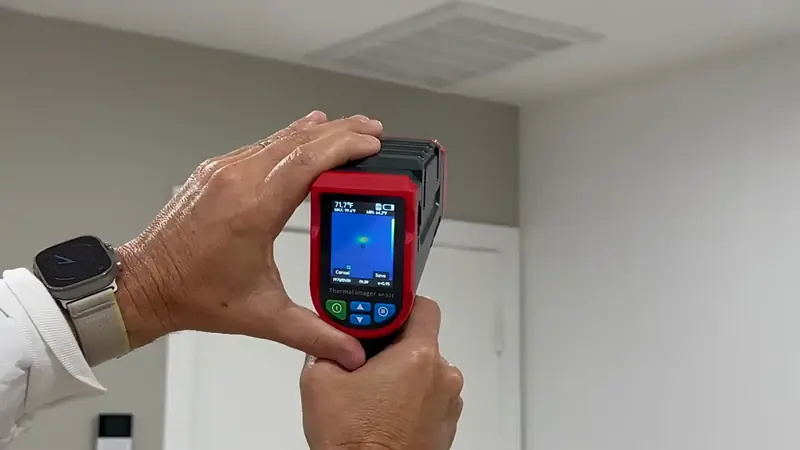
Thermal imaging uses an infrared camera to detect surface temperature variations that correspond to moisture content differences in building materials. Wet drywall, wet insulation, and wet framing are typically cooler than dry adjacent materials in heated Beaverton homes during the wet season -- the moisture absorbs heat as it evaporates, creating a temperature differential that the infrared camera images as a distinct color zone. A skilled thermal imaging technician interprets these temperature patterns to identify where moisture has migrated in a building assembly, even when the wet area is hidden behind a finished surface.
In Beaverton, thermal imaging is particularly valuable for two diagnostic tasks that acoustic detection handles less well: mapping the extent of existing moisture damage after a leak has been running for some time, and distinguishing between supply-leak moisture (which appears at a specific point corresponding to a pipe location and typically shows warm-source characteristics from hot water lines) and groundwater intrusion or condensation (which shows cooler, more diffuse patterns associated with cold exterior surfaces).
Thermal Imaging Applications in Beaverton Homes
Ceiling stain source identification: A brown ceiling stain in a Cedar Hills or Raleigh Hills home has migrated from the actual entry point through the floor assembly above. Thermal imaging of the ceiling surface shows the full moisture-affected area and, in many cases, shows a temperature gradient pointing toward the source -- where the cooler, wetter material concentrates indicates the direction of water migration. Combined with knowledge of what is above the ceiling, this often identifies the specific fixture or pipe run responsible without opening the ceiling.
Post-repair moisture verification: After a pipe repair and structural drying, thermal imaging confirms that the wall or floor assembly has returned to ambient moisture levels before new drywall or flooring is installed. Re-enclosing a wall assembly before it dries sufficiently traps residual moisture and produces a mold problem within weeks. Thermal imaging provides objective documentation that the assembly is dry before repair closure.
Insurance documentation: Thermal images of moisture extent before any demolition provide a documented record of the damage state at discovery -- useful for homeowners insurance claims where the extent of water damage is at issue. We provide thermal imaging reports that document the moisture boundary, the temperature differential at affected areas, and the interpretation of the moisture source.
PNW seasonal moisture vs. plumbing leak: Beaverton's wet season brings ambient humidity and groundwater pressure that can produce basement and crawlspace moisture patterns similar to supply-line failures. Thermal imaging distinguishes the two: supply-leak moisture often shows a point source with a temperature characteristic linked to the water temperature (hot for hot-water-line failures), while groundwater infiltration shows diffuse, even-temperature patterns at the foundation perimeter. This distinction prevents misdiagnosis and misdirected repairs.
For thermal imaging leak detection in Beaverton and Washington County, call (503) 974-3329. We use thermal imaging on every complex moisture assessment in Cedar Hills, Raleigh Hills, and Murray Hill homes where the moisture source is not immediately obvious from symptom presentation alone.
Frequently Asked Questions
Thermal imaging detects the temperature signature of moisture that has already migrated that has already migrated into the wall assembly, not the pipe failure itself. A supply-line pinhole that has been running for a week and has saturated wall insulation shows clearly in thermal imaging. A pinhole that started an hour ago may not yet have produced sufficient temperature differential to detect. Thermal imaging is most effective when some moisture has already accumulated in the building assembly -- it maps the extent of existing moisture, and the shape of that moisture pattern helps identify the source.
The two methods detect different things and are most powerful in combination. Acoustic detection locates the active failure point in the pipe -- the exact breach location. Thermal imaging maps where moisture has migrated from that breach into surrounding materials. For a wall leak where both the source location and the damage extent are unknown, using both methods in sequence provides the most complete picture: acoustic detection finds the pipe failure, thermal imaging shows how far the moisture has traveled from that point.
Thermal imaging documents the moisture extent at the time of discovery, before any demolition or drying occurs. This documentation shows the boundary of the damage, the severity of moisture saturation, and the location of the highest-moisture areas -- all relevant to the scope of a water damage insurance claim. Before-and-after thermal images also demonstrate that repairs were complete: a post-drying thermal scan showing the assembly returned to ambient temperature supports the claim that remediation was thorough.
Beaverton's wet season does affect thermal imaging in ways that require interpretation experience to navigate. During October-May wet season, exterior walls show temperature patterns from cold outdoor exposure that can resemble moisture intrusion patterns. Crawlspace humidity creates baseline elevated moisture readings in floor assemblies that are present regardless of plumbing leaks. Skilled thermal imaging interpretation accounts for the ambient temperature, the outdoor conditions, and the building construction when interpreting the images -- distinguishing seasonal climate effects from active moisture problems.
Need Thermal Imaging Leak Detection in Beaverton?
Oregon CCB licensed. Non-invasive detection first. Washington County specialists. 24/7 availability.
(503) 974-33299460 Adams St, Beaverton, OR 97003 | Washington County
Oregon CCB Licensed
Washington County Specialists
Non-Invasive Detection First
Thermal Imaging Leak Detection in Beaverton, OR
Same-day service across Washington County. Non-invasive detection. Oregon licensed.
(503) 974-3329