
Ceiling Leak Detection & Repair in Beaverton, OR
A brown stain on a Beaverton ceiling almost never originates directly above the stain. Water travels along joists, pipes, and subfloor sheathing before dripping at the lowest point -- often several feet from the actual entry point. We trace it back.
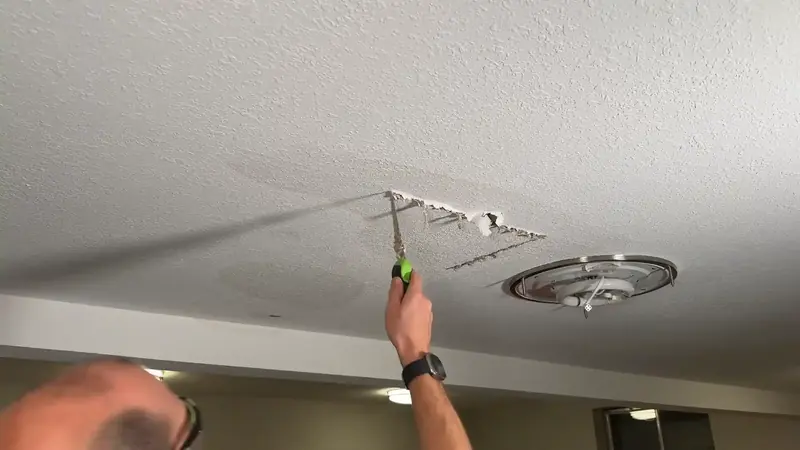
A ceiling stain in a Beaverton home is a symptom, not a location. Water that finds its way into a floor or ceiling assembly travels along the path of least resistance -- typically along a floor joist or the top surface of ceiling drywall -- before accumulating at a low point and dripping through. The brown ring that appears on a bedroom ceiling in a Cedar Hills ranch home may have entered the floor assembly three feet away at a toilet flange connection, migrated along a floor joist, and dripped at the lowest point above the ceiling below. Opening the ceiling at the stain location finds wet drywall but often no active drip source -- the actual entry point is elsewhere.
Our ceiling leak detection process does not start at the stain. It starts with identifying what is above the stain -- which room, which fixtures, which pipe routes, and which possible entry points exist in that space. We then work through those sources systematically from the most likely to the least, using thermal imaging to trace moisture patterns through the floor assembly and moisture metering to identify the extent of saturation before any access opening is made.
What Creates a Ceiling Stain in Beaverton Homes
Bathroom plumbing above: The most common ceiling stain source in Beaverton multi-story homes is a bathroom fixture failure on the floor above. Toilet wax ring failure, shower drain connection failure, bathtub overflow gasket failure, and supply line or valve failure above all route water into the floor assembly in the same general area. The specific fixture involved can often be determined from the geometry -- a stain directly below a toilet location suggests wax ring or supply connection; a stain below the shower area suggests pan, drain, or shower valve. We discuss our detailed bathroom leak assessment protocol with homeowners when a bathroom is the suspected source.
Supply pipe routing above: In Beaverton homes with supply pipes running through the floor cavity between levels -- common in older Central Beaverton and Vose homes where pipe routing followed the original construction rather than current code -- a pinhole in a copper line or a joint failure above can drip continuously onto the top of the ceiling drywall below. This type of failure does not correlate with fixture use -- it runs continuously and the stain grows slowly and steadily. The meter test identifies this as a supply-side failure, and acoustic detection locates the pinhole above.
Beaverton's rainy-season roof and flashing: October through May, Beaverton receives the bulk of its 37 inches of annual precipitation. Roof failures -- flashing separation at chimney bases, skylight seal failures, or damaged shingles on older Cedar Hills and Raleigh Hills homes with 30-year roofs -- produce ceiling stains that correlate with rainfall events rather than fixture use. A ceiling stain that appears during or immediately after a rain storm and dries between events points to a roofing or flashing failure rather than a plumbing source.
Condensation from HVAC or attic: Bathroom exhaust fans that terminate in attic spaces rather than exterior vents, poorly insulated cold water pipes that sweat in summer, or HVAC condensate drain failures above can all introduce ceiling moisture without any pipe failure. We distinguish these from active pipe leaks through temperature correlation -- condensation-sourced moisture in Beaverton is typically worst in summer on cold pipes or in humid conditions, while active plumbing leaks are temperature-independent.
For ceiling leak source detection in Beaverton and Washington County, call (503) 974-3329. We cover both plumbing and non-plumbing moisture sources and distinguish the source type before recommending any repair. Homeowners in Cedar Hills and Raleigh Hills with older two-story homes frequently encounter the multi-foot-migration pattern that makes ceiling stains misleading as to source location.
Frequently Asked Questions
Not reliably. Water entering a floor assembly migrates along joists, pipe routes, and the top surface of ceiling drywall before dripping at the lowest accessible point. The stain location identifies where water accumulated, not necessarily where it entered. The horizontal distance between the entry point and the stain can be several feet in Beaverton homes with longer joist spans. We always identify what is above the stain first and then trace the moisture path back from the stain to the actual entry point using thermal imaging.
Timing is the most reliable indicator. A plumbing leak produces ceiling moisture that is relatively constant and does not correlate with outdoor weather -- it may get slightly worse if a particular fixture is used frequently, but it runs on its own schedule. A roof or flashing failure produces ceiling moisture that appears during or immediately after rain events and dries between storms. Beaverton's distinct wet season (October-May) and dry season (June-September) make this correlation easy to observe: if the stain appears for the first time in October and grows through the wet season, a roof source is the first hypothesis to test.
Not recommended. A ceiling stain indicates that water has already entered the floor assembly above and saturated ceiling drywall below. The longer the moisture continues, the more floor framing material absorbs saturation, mold has the opportunity to establish, and ceiling drywall approaches the structural failure point. In Beaverton's humid PNW climate, mold can begin to develop in wet wall cavities within 24-48 hours. A stain that appears stable may reflect a slow active leak rather than a historical one -- the source confirmation step tells you whether the leak is still active.
Not necessarily during the detection phase. Thermal imaging maps the moisture extent and direction in the ceiling and floor assembly without any access cuts. In many cases, the thermal image clearly shows a moisture path leading back to a specific fixture or pipe location above, allowing the source to be confirmed from the space above without opening the ceiling at all. Access cuts are made for repair, not for detection, and we determine the minimum necessary access after the source is confirmed.
Need Ceiling Leak Detection & Repair in Beaverton?
Oregon CCB licensed. Non-invasive detection first. Washington County specialists. 24/7 availability.
(503) 974-33299460 Adams St, Beaverton, OR 97003 | Washington County
Oregon CCB Licensed
Washington County Specialists
Non-Invasive Detection First
Ceiling Leak Detection & Repair in Beaverton, OR
Same-day service across Washington County. Non-invasive detection. Oregon licensed.
(503) 974-3329