
Copper Pipe Leak Detection & Repair in Beaverton, OR
Beaverton's 1960s-1990s copper supply pipe is now in the peak failure window. Bull Run water's ultra-soft chemistry and 40-to-60 years of pipe age combine to produce the pinhole corrosion pattern driving copper leak calls across Cedar Hills, Garden Home, and West Slope.
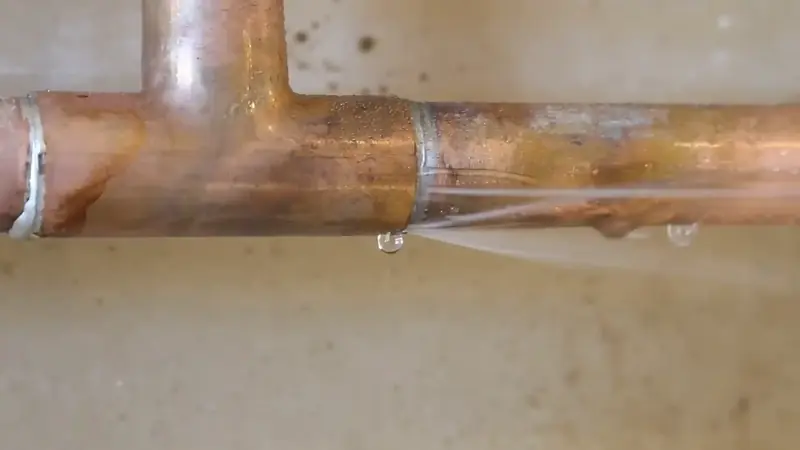
Copper pipe leak detection in Beaverton is a specialty in its own right because Beaverton's copper pipe failure pattern is shaped by a local water chemistry factor that does not apply everywhere. The city's primary water source -- Bull Run watershed water distributed by Tualatin Valley Water District -- is extraordinarily soft: under 10 milligrams per liter hardness, among the lowest in any major US metropolitan water system. That ultra-soft water, in the era before TVWD and the Portland Water Bureau implemented current pH corrosion-control adjustments, was slightly aggressive toward copper pipe -- slowly dissolving trace copper from the pipe interior, creating the pitting pattern that is now showing up as pinhole leaks in Beaverton's 1960s-1990s housing stock.
This is not a speculative claim. Copper pitting corrosion associated with soft, low-pH water is documented across the Portland metro area and discussed extensively in Portland Water Bureau corrosion-control compliance reports. The mechanism is well understood: soft water's low mineral content means it arrives at the pipe with less dissolved material than it can potentially hold, creating a mild driving force to dissolve additional minerals from contact surfaces. TVWD's current pH adjustment (targeting 8.8 for Bull Run-sourced water) addresses this going forward, but decades of pre-adjustment exposure have already created the pitting structure in older Beaverton copper.
Where Copper Pipe Leaks in Beaverton
The peak failure age for Beaverton copper is pipe installed between 1962 and 1988 -- now 37 to 63 years old. Cedar Hills, Garden Home, Highland Beaverton, West Slope, and parts of older South Beaverton represent the highest-density zone for this cohort. Copper in these neighborhoods has experienced decades of soft-water contact, and the pitting that formed during the lower-pH era is now reaching pipe-wall-depth at an increasing rate.
Copper also fails at soldered joints. A sweat-soldered fitting in a supply line experiences thermal expansion and contraction every time hot water runs -- hundreds of cycles per year, year after year. Over 40-50 years, those micro-movements can crack the solder seal or pull the pipe slightly from the fitting socket, creating a drip at the joint rather than a mid-span pinhole. These joint failures are more common at elbows, tees, and connections to fixtures or shutoff valves than in straight pipe runs. Our detection approach distinguishes between pinhole and joint failures because the repair scope differs: a joint failure is a targeted fitting replacement, while systemic pinholes may warrant a broader repipe evaluation.
Acoustic Detection for Copper Pipe Leaks
Pressurized copper supply lines are ideal candidates for acoustic leak detection. The sound that water makes escaping through a pinhole -- a high-frequency hiss or hiss-and-rumble combination -- travels well through copper and through drywall assemblies. A sensitive contact microphone held against the wall surface near a suspected area can resolve the signal to within a few inches of the actual failure point, allowing a single small access cut rather than exploratory wall demolition.
For multiple simultaneous pinholes -- which we frequently encounter on first-visit assessments of older Cedar Hills and Garden Home copper systems -- we supplement acoustic detection with pressure-zone isolation. Closing individual zone valves and watching pressure gauges tells us which sections of the copper system are actively losing pressure. Isolating the affected zone before acoustic scanning reduces the area we need to cover and improves detection accuracy.
For copper pipe leak detection in Beaverton and all Washington County neighborhoods, call (503) 974-3329. We also assess copper service laterals running from the TVWD meter to the house -- those lines are subject to the same soft-water chemistry as interior copper. Homeowners in Cedar Hills and Garden Home with homes in the 1962-1988 build range should consider a proactive copper assessment before the next pinhole appears.
Frequently Asked Questions
Copper pipe has a rated service life of 50-70 years under normal conditions. In Beaverton, the soft-water corrosion factor and the pre-pH-adjustment era of exposure mean that 1960s-1980s copper is showing pinhole failures at 40-60 years of age -- toward the earlier end of the service life range. Homes in Cedar Hills and Garden Home with original copper from the 1965-1985 period are now past the midpoint of their expected service life and approaching the failure window. The timeline varies by water exposure and the specific soil chemistry around any buried sections.
Individual pinholes can be repaired -- the failed section is cut out and replaced with new copper or a sharkbite-style push-fit connector. The question is whether an individual repair makes economic sense. If this is the first pinhole event in a 1985 Cedar Hills home, a targeted repair is reasonable. If this is the second or third pinhole in 18 months, or if acoustic detection finds multiple active pinholes in the same assessment, a repipe discussion is warranted -- because the pipe system has reached systemic failure age throughout.
Green or blue-green staining (verdigris) on copper pipe exterior, faucet bodies, or at threaded connections indicates active copper oxidation and is a reliable early warning sign of corrosion that will eventually lead to a failure. It does not necessarily mean there is an active leak yet, but it indicates the pipe is experiencing accelerated corrosion at that point. Green staining combined with a TVWD bill increase is a strong indicator of an early-stage copper leak.
Hard-water scale is the mineral deposit that accumulates inside pipes carrying high-mineral (hard) water -- it narrows flow diameter over time but the mineral coating also partially protects the copper wall from corrosive attack. Beaverton's Bull Run water is the opposite: extremely soft and low-mineral, meaning no protective scale forms. The copper interior has direct contact with slightly aggressive water without the mineral buffer. This is why the Portland metro area has documented copper pitting problems despite having excellent water quality by most measures -- the softness itself is the relevant factor, not contamination.
Need Copper Pipe Leak Detection & Repair in Beaverton?
Oregon CCB licensed. Non-invasive detection first. Washington County specialists. 24/7 availability.
(503) 974-33299460 Adams St, Beaverton, OR 97003 | Washington County
Oregon CCB Licensed
Washington County Specialists
Non-Invasive Detection First
Copper Pipe Leak Detection & Repair in Beaverton, OR
Same-day service across Washington County. Non-invasive detection. Oregon licensed.
(503) 974-3329